
Annapoorna chain of restaurants owner Srinivasan is seen purportedly highlighting concerns over varying GST rates. In the second video, Srinivasan was seen purportedly apologising in person to the Finance Minister.
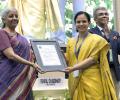
The GST Council has set up a Group of Ministers, chaired by Haryana Deputy Chief Minister Dushyant Chautala, to suggest required changes in the law for setting up the GST Appellate Tribunal (GSTAT). The GST Council, chaired by Finance Minister Nirmala Sitharaman and comprising state ministers, had last week decided to constitute a Group of Ministers (GoM) to address various concerns raised by states in relation to constitution of the GSTAT. As per the Terms of Reference (ToR) of the GoM, the panel would recommend required amendments in the GST law to ensure that the legal provisions maintain the right federal balance and are in line with the overall objective of uniform taxation within the country.

Some states are taking a legal view on the state GST rate and the compensation rules ahead of the Goods and Services Tax (GST) Council meeting, which is likely to be held in mid-June, said people in the know. While the agenda is still being finalised, several states are likely to take up the matter related to GST compensation and may pitch for its continuation beyond the June 30 deadline. States would like to know how they would divide the compensation collected after June 2022 for payment of principal and interest of compensation shortfall borrowing and arrears to states, sources said.
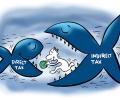
As Centre cedes power to states in indirect tax, it wants to all ystaffers' worry of little work.

Finance Minister Nirmala Sitharaman will present her 8th straight Budget and all eyes will be on the much-expected tax relief for the middle class. Sitharaman had in her first Budget in 2019 replaced the leather briefcase -- which had been in use for decades for carrying Budget documents -- with a traditional 'bahi-khata' wrapped in red cloth.
.jpg)
The GST Bill, introduced in Parliament in 2010, is being vetted by the Standing Committee on Finance. Now, the states and the Centre would together finalise the draft and bring it back to Parliament.
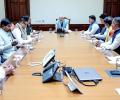
The change in the government's engagement with the economy's need for reforms is more nuanced than how analysts have so far perceived it, points out A K Bhattacharya.
Finance Minister Arun Jaitley to discuss key issues with state finance ministers.
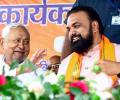
Jan Suraaj Party founder Prashant Kishor alleges Bihar Deputy Chief Minister Samrat Choudhary escaped a murder trial by falsely claiming to be a minor. He demands Choudhary's dismissal and threatens to expose further financial irregularities.

Finance Minister P Chidambaram on Monday exuded confidence that the centre will be able to sort out the issues concerning implementation of the Goods and Services Tax (GST) shortly.

Online skill-based gaming industry has made a case for retaining the service under 18 per cent GST slab instead of putting it into the highest 28 per cent tax rate category, saying the move will badly hit the $2.2-billion sector. The increase in taxation would not only have catastrophic impact on the industry but also encourage offshore operators who would circumvent Indian tax jurisdiction by hosting games in some other country, Games24x7 Co-CEO Trivikraman Thampy said. "It would be a triple whammy -- the industry loses out, the government loses out on tax revenue and players loses out as they would be exposed to unscrupulous operators," he said.
The Congress, however, said it wanted to see the final print on the wording of the dispute resolution mechanism before committing its support to the Bill

The GST Bill, seen as single biggest tax reform in a long time, needs to be ratified by at least 15 state legislatures before the President can notify the GST Council which will decide the new tax rate and other issues
The disagreement between the Centre and states continued over administrative powers.
The GST Constitutional Amendment Bill is with the standing committee.
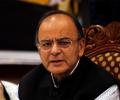
Officers from various departments including the finance ministry to be part of rehearsal event
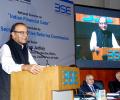
The government has proposed to implement GST from April 1, 2016, and the new Finance Commission may be set up ahead of its schedule to look into the issues related to the new indirect tax regime.

The GST will replace more than a dozen levies central and state levies, including central excise duty, service tax and central sales tax as well as VAT on sale of goods and entry tax, to make movement of goods seamless across 1.3 billion market.

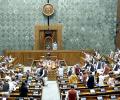
India's opposition parties have sharply criticized the Union Budget, calling it inadequate to address the country's economic woes and accusing the BJP-led government of using it to woo voters in Bihar and Delhi ahead of upcoming elections. Leaders from the Congress, TMC, DMK, SP, and CPI(M) voiced their disapproval, highlighting concerns over inflation, unemployment, and the lack of substantial measures to support the agricultural sector and the poor. They also criticized the tax cuts for the middle class as insufficient and coming too late after years of high taxes and rising prices.
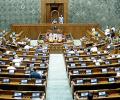
Bharatiya Janata Party on Thursday issued a three-line whip to all of its Lok Sabha MPs asking them to be present in the House for the passing of the Union Budget 2025-26.

Chaudhary also said that 66 per cent of government-sponsored health insurance schemes in the country are being run by the central government. "When the COVID-19 pandemic started, a decision was made for sale of all medicines at the GST rate between 5 and 12 per cent and the GST rate for COVID-19 related medicines and instruments has been reduced to five per cent," he said during the Question Hour.

Some also demanded empowering of local bodies.
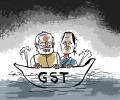
Even with the Rs 20,000 crore distributed among states, it will still be a fraction of what they have been demanding in financial support and clearance of pending dues.

After failing to convince states to keep petroleum products within the ambit of the proposed goods and services tax (GST), the Centre has finally relented. It has agreed to the proposal of the empowered committee of state finance ministers to keep petroleum products like crude, motor spirit, aviation turbine fuel (ATF) and high-speed diesel out of GST.

The next meeting of the GST Council will be held on September 28-29 in Goa.
Sree Annapoorna Sree Gowri Shankar is a familiar name across the country. With over 1,500 employees, it is renowned for its filter coffee and Keerai Vada throughout Tamil Nadu. Its operating revenues range from Rs 100 crore to Rs 500 crore.
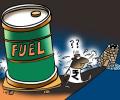
The GST Council might on Friday consider taxing petrol, diesel and other petroleum products under the single national GST regime, a move that may require huge compromises by both central and state governments on the revenues they collect from taxing these products. The Council, which comprises central and state finance ministers, in its meeting scheduled in Lucknow on Friday, is also likely to consider extending the time for duty relief on COVID-19 essentials, according to sources in the know of the development. GST is being thought to be a solution for the problem of near-record high petrol and diesel rates in the country, as it would end the cascading effect of tax on tax (state VAT being levied not just on the cost of production but also on the excise duty charged by the Centre on such output).

Here's everything you need to know about the Goods and Services Tax Bill.

While the government has the option of ensuring the passage of these Bills as money Bills, there are voices within the government advising discretion on the GST roll-out by April 1.
Petroleum products such as crude, motor spirit and diesel, and alcohol beverages will be kept outside the dual goods and service tax (GST) structure, which will be implemented from April 2010.
Performance-based incentives were recommended by the 13th Finance Commission, but omitted by the 14th Finance Commission
Besides central cess, the Empowered Committee of State Finance Ministers has also recommended to keep purchase tax and octroi, which are collected at state and local levels, outside the GST framework.

The central government, in its revised draft of the constitution amendment bill, had proposed that fuel and liquor should be brought under the ambit of GST.

'From the tiniest to mid-level organisations and even some at the lower end of the large-scale ones would say that computerisation and the extensive documentation and regulatory requirements for GST have made the compliance process worse in many cases.'
Finance Minister Pranab Mukherjee on Wednesday proposed a three-rate structure for the Goods and Services Tax -- which will simplify the indirect tax regime -- under which goods will attract 20 per cent levy, services 16 per cent and essential items a concessional 12 per cent.

The Supreme Court on Thursday ruled that the Goods and Service Tax (GST) Council's recommendations are not binding on Union and State but have a persuasive value as the country has a cooperative federal structure.

The Lok Sabha has already passed the Bill.
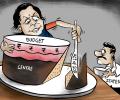
Kerala Finance Minister KN Balagopal on Friday urged the Centre to provide more fiscal powers to the states as well as increase the shareable proportion of the GST collections. Besides, he asked the central government to expedite approval for the semi-high-speed railway line or the Silverline project from Thiruvananthapuram to Kasargod. The project is mired in controversies.

Union Finance Minister Nirmala Sitharaman on Tuesday said the mass consumption items such as pulses, wheat, rice, flour, and curd will not attract the 5 per cent goods and services tax (GST) when sold loose, and not pre-packed or pre-labelled. The clarification came amid protests and widespread criticism by Opposition Members of Parliament over foisting GST on daily-use essentials and subsequent price rise. The all-powerful GST Council, chaired by the Union minister, had last month decided to impose GST on some mass consumption items to simplify the rate structure, which came into effect on Monday.
